


 Top writing services
Why Generated Content Has Become a Problem
Let's clear the air: The rise of neural networks and AI content generators isn't signaling the end times. However, their misuse is creating a dilemma of academic integrity issues. Students, possibly desperate or lazy, use these tools to cobble together papers, and the results are often cringeworthy. Academic rigor? Out the window. Readability? A mess. It's not even necessary for a professor to deploy what is the best AI detector to sense that something's awry with the paper.
The quality speaks for itself, or rather, screams. The same holds for disreputable writing services. These platforms leverage AI to produce a torrent of bland, repetitious assignments, hoodwinking students into believing they get a custom piece. I couldn't sit back and watch this digital travesty unfold, so I dissected the AI boogeyman haunting our academic lives.
Top 5 Best AI Detectors: My Experience
I was tired of being a passive observer in this landscape of academic turmoil. So, I decided to roll up my sleeves and test out the five most prominent AI detection tools on the market. My experiment was a cocktail of both free and premium options. To keep things transparent, I used five texts penned by yours truly and another five generated by various neural networks. My text samples ranged from straightforward prose to intricate pieces with elaborate instructions. Trust me, stick around if you're a student looking for an AI checker essay. The revelations are eye-opening.
Winston AI
"Out of the sea of options, Winston AI stood tall. Its finesse in detecting neural network-generated content was almost eerie. I was not prepared for an 84% overall accuracy score. This AI essay detector nailed every GPT-4 generated text and had zero false positives. And here's the magic trick: it even managed to detect AI text muddled with human content or altered by a paraphrasing tool.
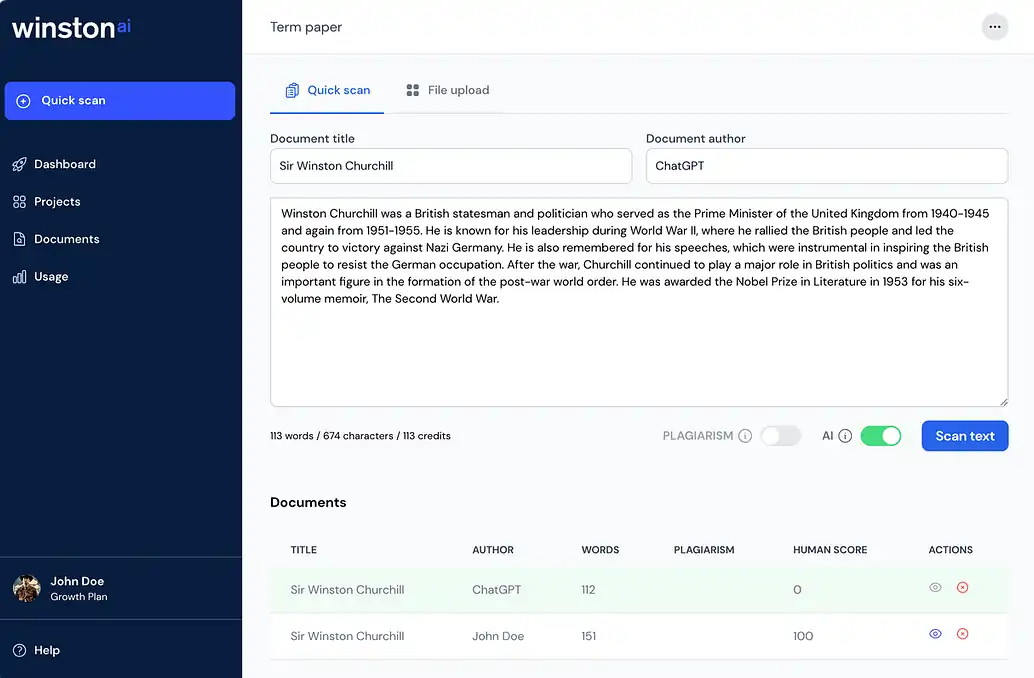
What impressed me further was the digestibility of the output. It gives you a percentage and colored highlights to identify suspected AI-generated text. But let's be honest, it's not all sunshine and rainbows. The interface requires more patience than I'd like, with multiple clicks needed to arrive at the scan results.
Pros:
- Astounding 84% overall accuracy;
- zero false positives;
- efficient at detecting mixed AI and human content;
- clear output in percentage and color-coded text.
Cons:
- Requires sign-up;
- multiple clicks are needed for scan completion;
- premium service at $18 per month;
- limited free trial of 2,000 words or one week.
Originality.AI
Next on my testing list was Originality.ai, which did a decent job, almost breathing down Winston AI's neck regarding performance. This AI paper checker clocked in an accuracy of 76% and was the only one that sniffed out the use of paraphrasing tools more than half the time. The striking feature was its ability to detect subtle mistakes and poor styles, offering a more nuanced scan. It even flagged some forms of plagiarism.
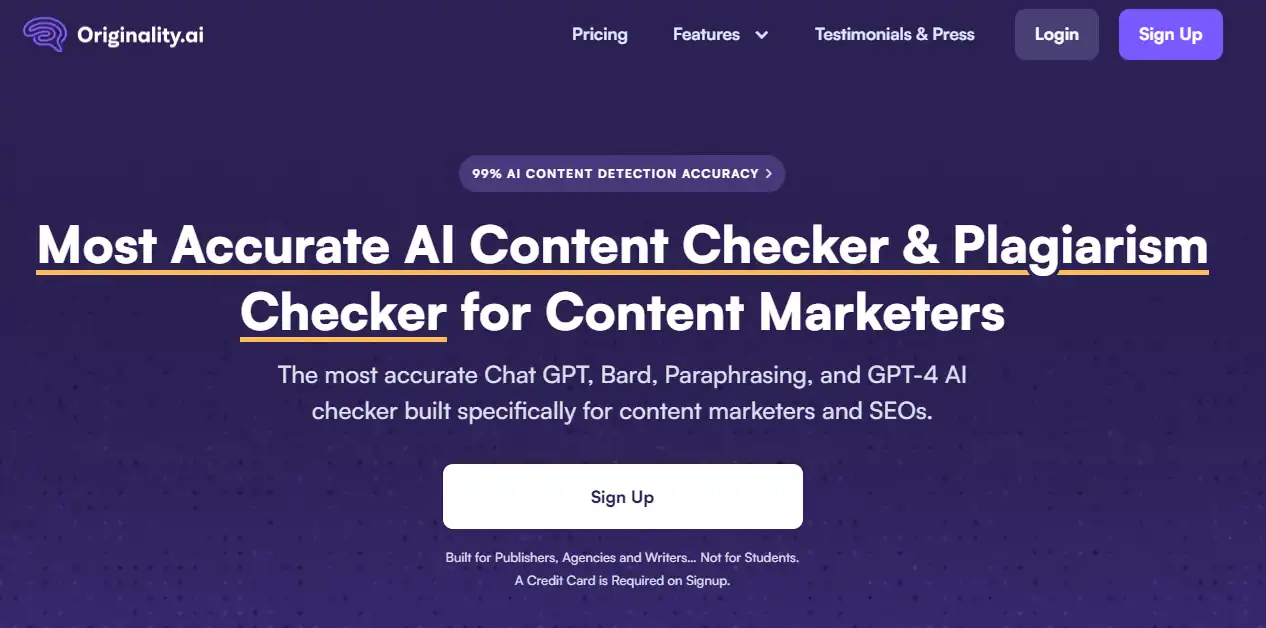
However, there's a caveat: the relationship between the highlighted text and the percentage it provides is ambiguous. It leaves you wondering how to reconcile the two kinds of feedback. The tool is not cheap either; even though you're getting more words for your buck, the lower accuracy could be a deal-breaker for some.
Pros:
- High accuracy at 76%;
- detects the use of paraphrasing tools;
- identifies mistakes and style variations;
- flags potential plagiarism.
Cons:
- One false positive during testing;
- ambiguous relationship between percentage and highlighted text;
- requires a sign-up for use;
- minimum spend of $20 to get started.
CopyLeaks
I also took CopyLeaks for a spin, wondering if a free tool could go toe-to-toe with the paid alternatives. The Copyleaks AI detection system notched an accuracy rate of 66%, making it quite reasonable among free options. To answer the burning question, "Is Copyleaks accurate?" – it's a bit of a mixed bag. It had no false positives and picked up more than half of the GPT-4-generated texts, which is not terrible for a free tool.
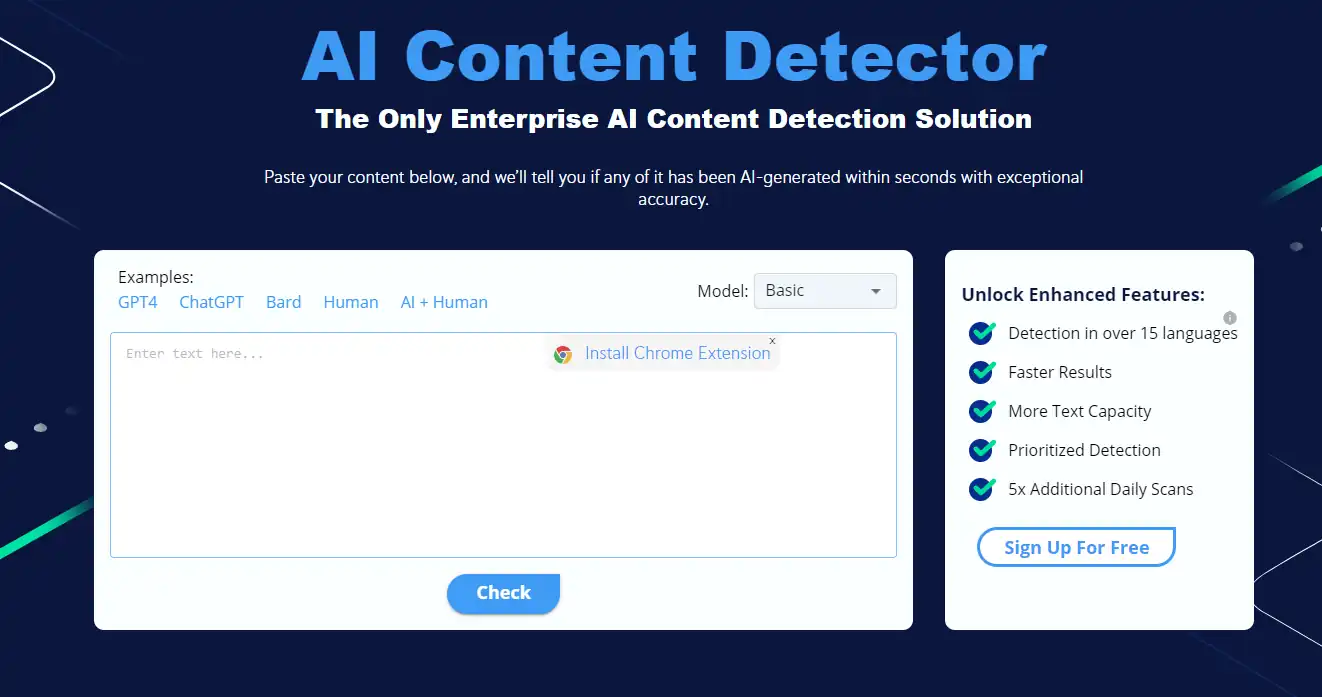
That said, its user interface leaves much to be desired. First, it doesn't provide an overall percentage of the text's AI-generated content. You see highlights and mouse-over percentages, but it's like trying to solve a riddle to understand what those numbers mean. Plus, it restricts the number of daily checks. So, while it's not useless, it certainly wouldn't be my go-to for rigorous academic scrutiny.
Pros:
- Free to use;
- no false positives;
- detects GPT-4 texts to some extent;
- no sign-up is required for basic use.
Cons:
- Confusing interface;
- no overall AI content percentage was provided;
- a limited number of daily checks;
- results are not clearly explained.
ZeroGPT
Next on the list is ZeroGPT, another free option that's particularly interesting for educators; it's an AI checker for teachers who want a quick read on whether a text has been machine-generated. With a 64% accuracy rate, it's not the most reliable in the business, but it's good enough for general use.
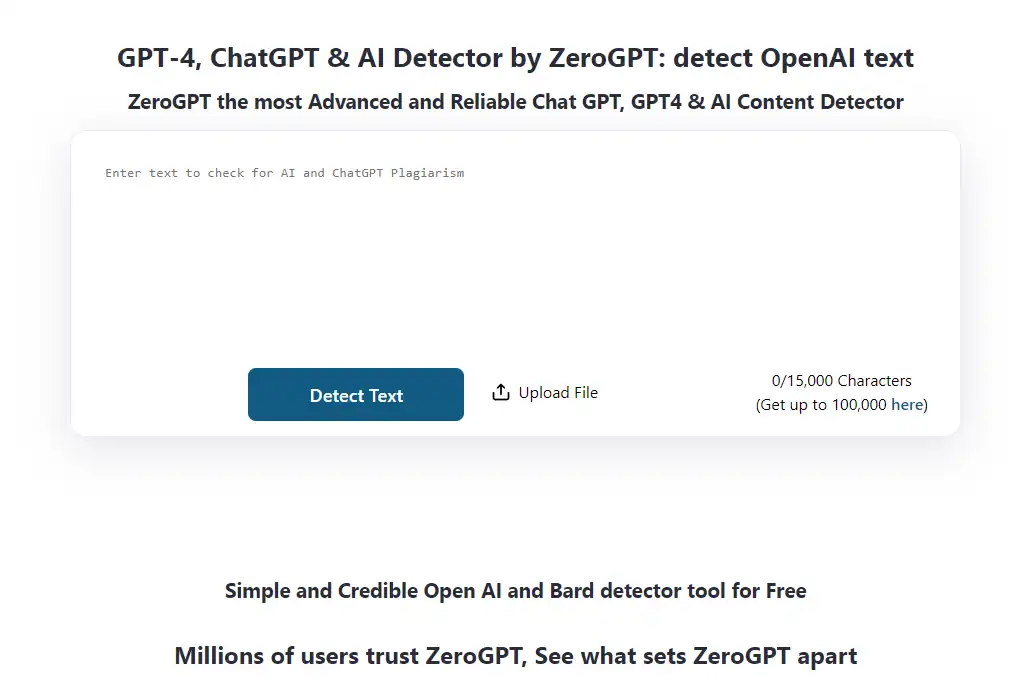
The interface is quite straightforward. Just paste your text, and it spits a percentage and some text highlights. It's great for teachers because it even provides a text label like "Your Text is AI/GPT Generated," offering a quick verdict. But be wary – there's a catch. The label sometimes doesn't jibe with the percentage it gives, which can be a bit perplexing.
Pros:
- Free and easy to use detector;
- no sign-up is required;
- gives a percentage and highlights;
- fairly accurate for a free tool.
Cons:
- Inconsistency between text label and percentage;
- one false positive in testing;
- missed detection on some GPT-3.5 texts;
- not 100% reliable for academic scrutiny.
Writer
Lastly, there's Writer, a tool I initially had high hopes for as it claimed to be the best Chat GPT detector. If you're looking for something great for editing tools or detecting AI-generated content, you might be inclined to check it out. Let me stop you right there – don't bother. My experience was nothing short of frustrating.
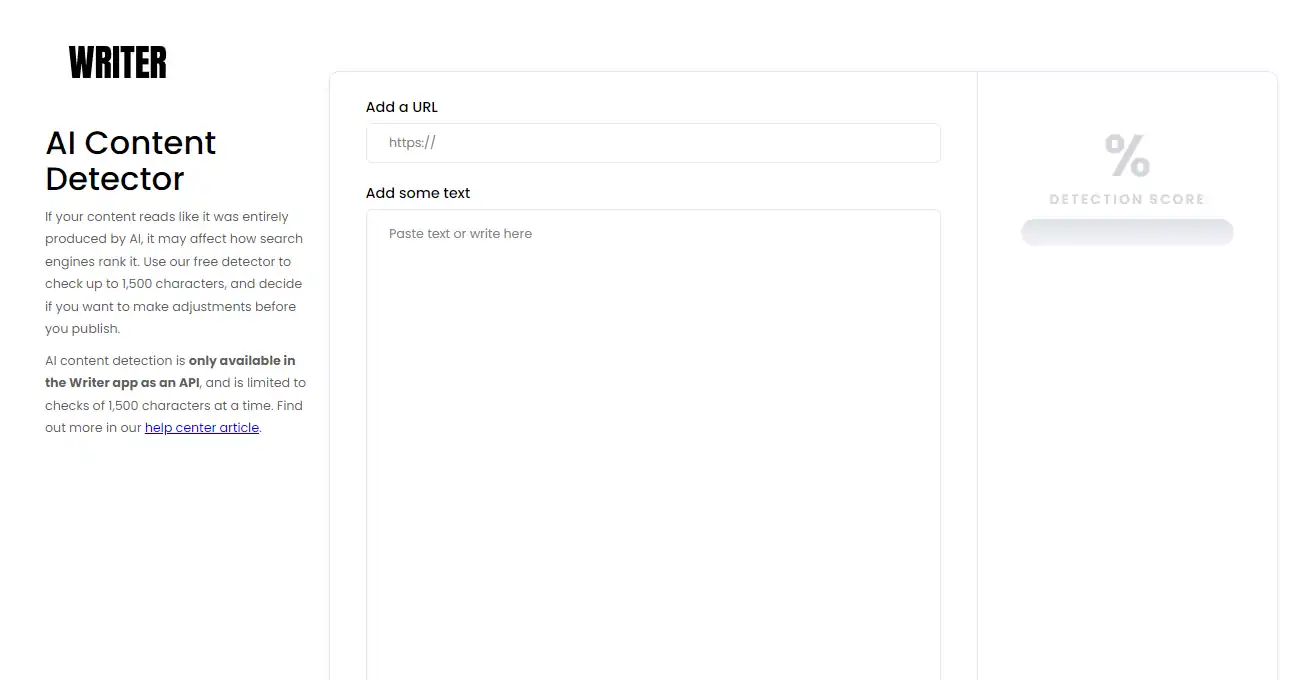
It started with an unpredictable interface; the tool often failed to load results. I had to give it several tries before I could even review its efficacy. Even when it finally decided to work, the accuracy was abysmally low, coming in at just 38%. Its claim to detect GPT-4 texts was entirely baseless; it couldn't identify any. It also offered limited character input, further adding to the inconvenience.
Pros:
- Free to use;
- no sign-up is required;
- no false positives;
- offers a percentage of human-generated content.
Cons:
- Frequently fails to load results;
- very low accuracy rate;
- cannot detect GPT-4 texts;
- limited character input allowed.
Notable Mention: Turnitin
Now, how could we talk about AI detectors without mentioning Turnitin? Known for its plagiarism detection capabilities, Turnitin recently decided to venture into AI-generated text parsing. But how does Turnitin AI detection work? Let's just say the results were underwhelming. Although Turnitin is mum about how AI detection works, its efficacy in identifying AI-generated content is average. During my tests, the module only managed to flag plagiarism in 50% of the cases.
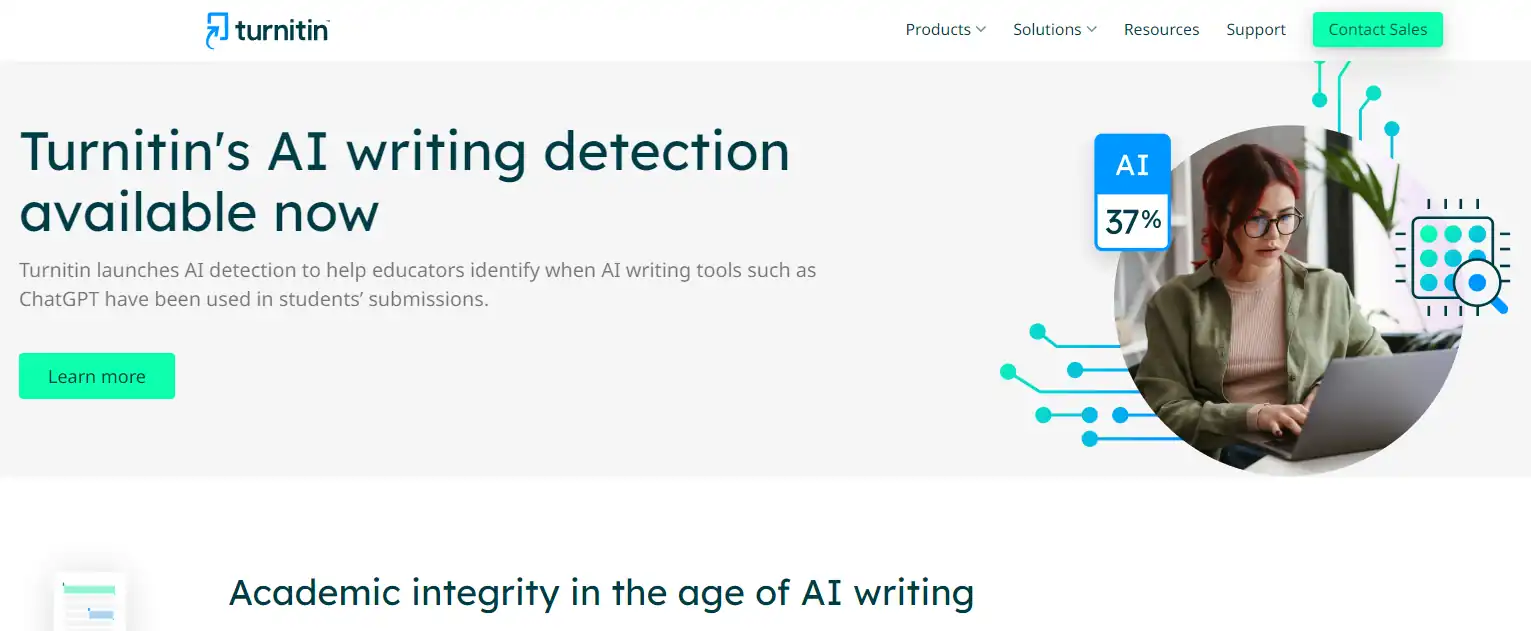
Regarding Copyleaks vs Turnitin, the former was noticeably better in identifying neural network-generated texts. As for the burning question, "Can Turnitin detect Quillbot?" – the answer is a disappointing no. While the company has made strides in offering what could potentially be the best originality AI review, it's clear they've got a long way to go.
So there you have it – my deep dive into the murky waters of AI detection tools. Each has its merits and shortcomings, but the key takeaway is that there's room for improvement. For now, tread carefully and always double-check those essays.
Challenges Associated with AI Detection Services
I don't want to downplay the value of AI detection services; they have their merits. However, let's not beat around the bush: these tools have issues. False positives are one of the biggest headaches. For instance, an originality AI detector might flag a genuine academic work as machine-generated, causing unnecessary trouble.
The next challenge is the lack of transparency in operation algorithms, which hampers understanding of the tool's accuracy. Many services suffer from inconsistencies; one day, they catch machine-generated text, and the next, they don't. Odd labeling practices add another layer of complexity.
"Sapling AI detector" showed strange approaches to labeling generated text that confused me. Then comes everyone's question: "Does undetectable AI work?" The short answer is, sometimes, but it's a gamble. AI detectors still have a long way to go in understanding language models and expanding their knowledge base to become foolproof.
FAQ
How accurate are AI detectors?
The answer isn't straightforward because the companies behind these tools – like Undetectable.ai, Originality.ai, and ZeroGPT – are pretty tight-lipped about their inner workings. What's certain is that these detectors can often sniff out machine-generated content, especially if the text is fairly generic. However, they're not infallible; false positives are a genuine concern. So, it's wise to double-check before crying wolf and accusing someone of using AI.
How can I detect AI writing?
Well, you're in luck because the tools I've covered above – like Turnitin.com and CopyLeaks – are designed to help you spot robotic prose. But bear in mind these programs can't guarantee 100% accuracy. Stealth AI detection is still a work in progress. If you want another layer of assurance, use your judgment. Machine-generated texts often come off as odd or lack a natural structure.
Can I use AI language models to write my paper?
Frankly, this isn't your brightest idea. AI language models lack the sophistication needed to follow complex academic guidelines. The quality of the generated text often falls flat, containing academic inaccuracies, conceptual mix-ups, and a slew of grammatical mistakes. Given the availability of check services, your professor would likely catch on pretty quickly, and trust me, you don't want to go down that road. So, while artificial intelligence is making strides, it's not yet ready to ace your paper.

