


 Top writing services
When I first ventured into the intricate realm of literature and content, one specific form of writing caught my attention: the expository essay. Through rigorous research and personal experiences navigating the literary world, I realized that understanding this form is crucial for anyone looking to communicate effectively. By the end of this extended article, you'll understand what is expository writing, what is a expository essay and how to find a writer or service adept at creating such content?
What Is Expository Writing?
To begin with, let's demystify the term. Expository writing is a type of writing that imparts information, shares knowledge, and clarifies intricate concepts. Its primary goal isn't to entertain or persuade but to inform. What is expository writing examples? The etymology of 'expository' can be traced back to 'expose'—and that's exactly what this writing aims to do: expose facts without the flair of personal opinion or narrative arcs.
Historical Context of Expository Writing
The roots of expository essays can be traced back centuries. Historians, philosophers, and scholars have used this form to share knowledge, document discoveries, and educate their peers. For instance, many ancient texts and scriptures that shed light on a civilization's practices, values, and knowledge can be seen as expository text examples from history.
Who Writes It and When?
Expository writing is prevalent and traverses multiple domains:
- Academicians and Students: Students from middle school to graduate programs often encounter some types of expository essay in their academic journey. It's a tool for educators to assess comprehension and critical thinking.
- Journalists and Reporters: News articles, particularly those in the realms of science, technology, and academia, use expository writing to present unbiased information.
- Professionals: Think about the user manual of your latest gadget or a business's annual report. Both are expository writing examples that elucidate processes or present data without bias.
- Authors: Many non-fiction writers, especially those dabbling in history, science, or self-help, use expository writing to convey knowledge and insights.
Types of Expository Writing
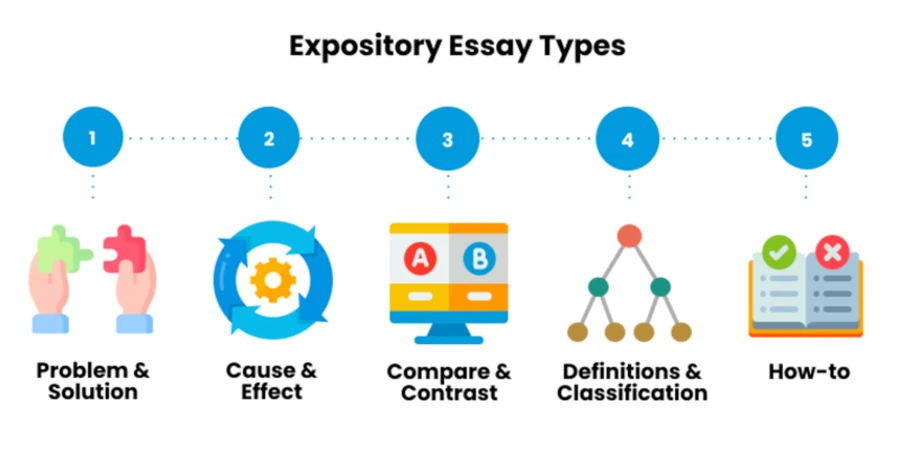
During my extensive reading and analysis, I've identified the core types of expository writing:
- Descriptive Essay: A meticulous portrayal of an event, place, or entity. It paints a vivid picture, allowing readers to visualize the subject. For instance, describing the serene landscapes of the Scottish Highlands would fall under this category.
- Process Essay: Ever come across articles titled 'How to Bake a Chocolate Cake' or 'Steps to Assemble a Bookshelf'? These are process essays. They provide a systematic guide, walking the reader through a particular task.
- Comparison Essay: As the name suggests, this essay contrasts two or more subjects. A piece analyzing the leadership styles of Winston Churchill and Franklin D. Roosevelt, highlighting their strategies during WWII, would be an example of expository focusing on comparison.
- Cause and Effect Essay: This format delves deep into the reasons behind occurrences and their outcomes. For instance, an essay exploring the causes of the 2008 financial crisis and its ramifications on global economies would be a type of writing expository.
- Problem and Solution Essay: A format that pinpoints an issue and proposes remedies. For instance, discussing the problem of plastic pollution in oceans and suggesting sustainable alternatives.
- Definition Essay: These essays define and provide a deeper understanding of complex terms or concepts. An article explaining the concept of quantum physics or the philosophical notion of existentialism would fall under this category.
- Classification Essay: These essays break down a broad topic into categories or groups. For example, classifying types of writing expository like renewable energy sources: solar, wind, hydroelectric, and geothermal.
Delving Deeper: Expository Writing Types in Practice
To better understand expository writing types, let's delve deeper into a couple of these types with an example of the exhibition:
- Descriptive Essay: Imagine walking through a dense forest, with sunlight filtering through the canopy, casting dappled shadows on the ground. The air, fresh with the scent of pine, carries the distant sound of a babbling brook. Birds serenade with their melodic tunes while the soft rustle of leaves underfoot accompanies each step. This imagery-heavy description is the essence of a descriptive essay.
- Comparison Essay: Consider the digital assistants Siri and Alexa. While both serve as voice-controlled aids, Siri is integral to Apple devices. In contrast, Alexa is synonymous with Amazon's Echo. Their functionalities overlap, yet each has unique features tailored to their parent company's ecosystem.
How to Find a Writer or Service and Which One is the Best?
Suppose you aim to produce expository content or need assistance with expository essays. In that case, finding a competent writer or service is crucial. Here's a comprehensive guide:
Reviews and Testimonials
When selecting a writer or a service, especially in a domain as nuanced as expository writing, it's paramount to make decisions grounded in research.
On such platforms, you can find first-hand experiences from individuals who have previously engaged with the writer or service you're considering. The advantage? They've crossed the path you're about to walk on. They've faced the pitfalls, reaped the benefits, and now share their stories. The positive or negative feedback gives an unfiltered view of what you can expect.
Sample Work
The proof, as they say, is in the pudding. Before entrusting a writer with your project, getting a taste of what they can offer is essential. It is where samples come into play. You get a tangible representation of a writer's capabilities by requesting expository text examples.
These samples serve multiple purposes:
- Style Assessment: Every writer has a unique voice. Reading samples helps ascertain if their style aligns with your vision and audience's preferences.
- Depth and Proficiency: A cursory glance at a sample can highlight the writer's grasp of the subject. Does the content skim the surface or delve deep, uncovering nuances?
- Accuracy and Authenticity: Check for factual accuracy. Misinformation can erode trust. Also, ensure the content is original and not plagiarized.
Poring over samples has often been the deciding factor in my endeavors, giving me clarity when torn between options.
Expertise in the Subject
Expository writing is all about elucidation and clarity. A writer unfamiliar with the subject might provide generic information. Still, one well-versed in the topic can weave in-depth, nuanced narratives.
This expertise can stem from formal education, professional experience, or extensive research. For instance, an essay on quantum physics would benefit from a writer with a background in physics or someone who has extensively covered the topic in previous writings.
Turnaround Time and Cost
Time and money — are two resources we often find ourselves juggling. When commissioning expository content, these factors invariably come into play.
Turnaround Time
Hastily produced content might lack depth or contain errors. Discuss timelines with your writer, ensuring they have adequate time to produce quality work.
Cost
An excellently crafted, well-researched expository piece can engage readers, provide value, and establish authority. It's an investment that often yields long-term dividends.
While I've occasionally faced the allure of quicker, cheaper options, I've realized the actual value of patience and quality. A meticulously crafted expository essay is, without a doubt, worth its weight in gold.
In Conclusion
In its various forms, expository writing remains an invaluable tool for disseminating information. From the nuances of a descriptive essay to the logic-driven cause-and-effect pieces, expository content offers clarity and depth. If you're on the hunt for quality content, always remember to do your homework.
FAQ
What is expository writing?
It's a style that imparts information and clarifies concepts, focusing on informing rather than entertaining.
Who uses expository writing?
Academicians, students, journalists, professionals, and non-fiction authors.
What are the main types of expository writing?
Types include Descriptive, Process, Comparison, Cause and Effect, Problem and Solution, Definition, and Classification essays.
Why is expository writing important?
It ensures clarity in presenting unbiased information across various domains.

